
A Critique of Sectoral Bargaining
By Josh, a worker at Urban Justice Center
ALAA’s 2025 sectoral bargaining effort showed that coordination without binding unity left workers divided and weakened their leverage. To win real power, the union must move toward truly collective strikes, a master contract, and integrated political and shop-floor organizing.
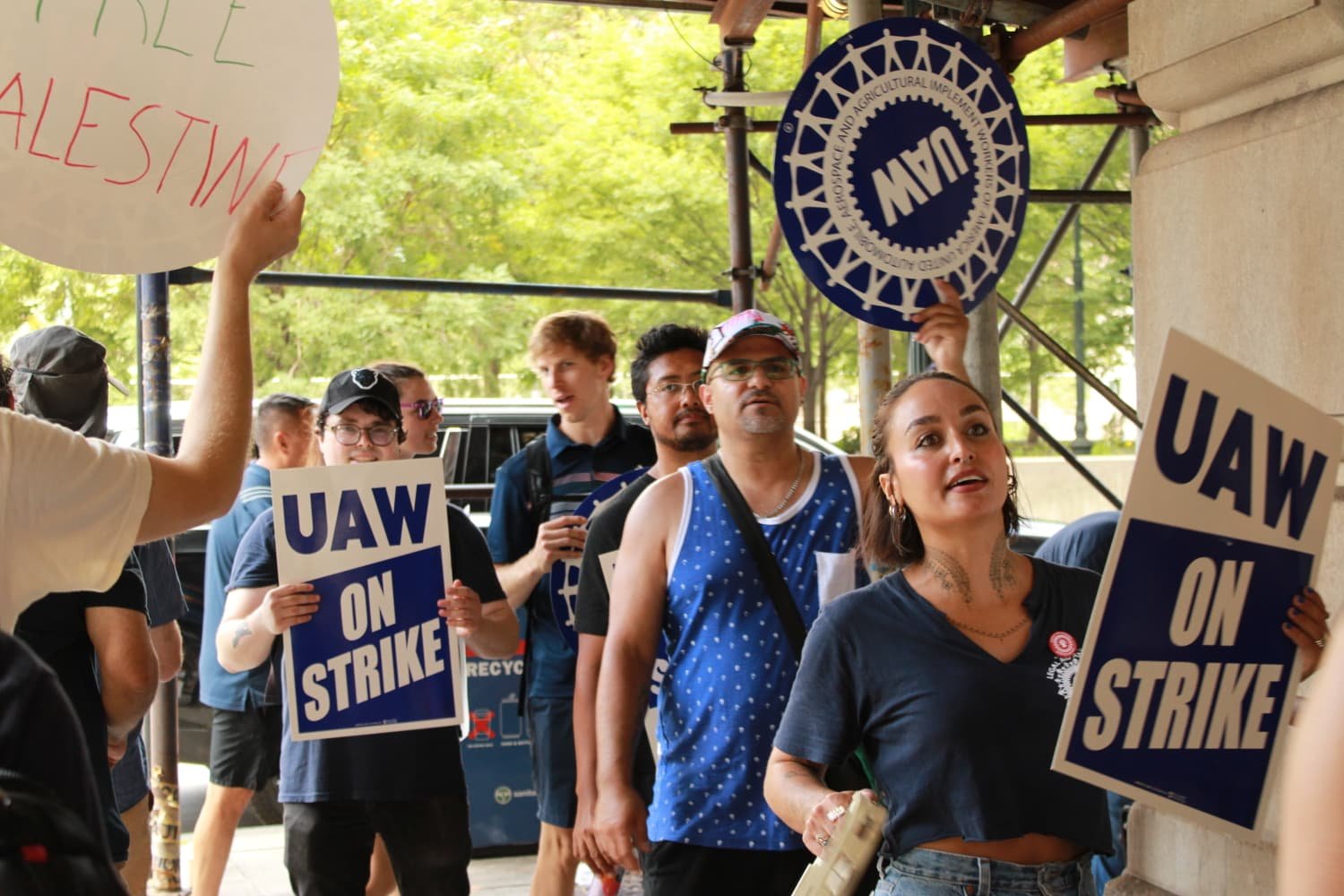
Workers at the Urban Justice Center picket outside their office — Summer 2025
The purpose of this article is to provide a sober assessment of the structural flaws of sectoral bargaining from the perspective of a participant in the 2025 New York City Legal Services Workers Strike. My hope is to start a conversation on how to address these issues and to provide a direction towards improvement.
During the summer of 2025, I was the Chapter Chair of the Urban Justice Center Union, when we participated in sectoral bargaining under the leadership of the Association of Legal Advocates and Attorneys (ALAA) and joined a strike of over 2,000 legal services workers in New York City. I also personally served on the Urban Justice Center Union’s bargaining committee during our contract negotiations with management.
This article is based on my personal experience in these roles and my study of the history of sectoral bargaining in the legal services sector in New York City.
Birth of ALAA and the Current Legal Services Landscape
In 1965, following the Supreme Court’s landmark decision in Gideon v. Wainwright (1962) which established the right to publicly funded criminal representation to all indigent defendants, the City of New York entered into a public-private partnership with The Legal Aid Society and designated it as its primary defender in New York State Courts. Four years later, The Legal Aid Society’s attorneysunionized as the Association of Legal Aid Attorneys (ALAA).
In the following decades, ALAA became a counterweight not just to management but to the municipal and state government as well. As the union for the city’s primary criminal defender, ALAA was highly effective not only at securing better salaries, benefits, and working conditions for its members, but also at using its considerable influence to advocate for criminal defendants. ALAA used its bargaining power to advocate for continuity of representation, confidential interview conditions, language access, and increased staffing, among other concessions favoring The New York Legal Aid Society’s clients.
However, by the mid-1990s, ALAA’s power and influence would be diminished by the City. In 1993, former federal prosecutor Rudy Giuliani won a hotly contested mayoral election against incumbent Mayor David Dinkins. Mayor Giuliani rode into office on a fearmongering tough on crime campaign that at times crossed the line into explicit racism.
During its first year, the Giuliani administration moved to simultaneously cut public spending across the board and further overcrowd the City’s packed jails. Predictably, this led to a showdown between ALAA and the Giuliani administration when ALAA voted to strike. Committed to union busting broadly, and diminishing the power of public defenders specifically, the Giuliani administration immediately canceled the City’s contract with The Legal Aid Society. Faced with catastrophic consequences, including having its members barred from working for the city in the future,ALAA was forced to make hard concessions and the best of a difficult situation.
However, this was not enough for the administration which instituted a series of reforms that crippled ALAA’s bargaining power. For the first time in decades, the City put out contracts to other non-profit legal service providers,while banning Legal Aid Society from bidding on them, splitting responsibility for the City’s indigent criminal defense among various disparate entities, many of which were not unionized until as late as 2020. This effectively ended ALAA’s ability to influence public policy and greatly diminished its leverage in seeking concessions for even its own members.
Even as many of the legal services providers that formed as a result of the Giuliani reforms proceeded to unionize over the following decades, the nascent union chapters found that their bargaining power was greatly constrained. Instead of negotiating as a single entity against a single employer, the chapters found themselves isolated during negotiations as individual chapters fighting countless individual battles against individual employers. Not only does this mean that no legal services union can ever exert the same pressure on the City, the ultimate employer, but the City can pit the employees at these various providers against each other by forcing bidding down of wages.
Looking at the bigger picture, what we see is another chapter in the history of class struggle. The capitalist class through its flunkies in city government launched a sustained assault against the City’s legal service workers. The first salvo in this battle was the creation of a public-private partnership. Providing constitutionally mandated legal services through a public private partnership adds a layer of insulation between the City and the legal services workers it hires. The City avoids having to give these workers the benefits and protections typically afforded to municipal employees and can, to a certain degree, off-load any political backlash for employment practices to its private partner.
However, this strategy initially backfired. Under federal law, public sector workers are not granted a legally protected right to strike, but private sector workers are. As a result, after ALAA was formed it developed into a militant union with the federally protected ability to shut down the court system in the City by striking.
The City, finding itself on the losing end of the class struggle, retaliated by fragmenting legal services into a multitude of rump organizations. The unionizing of the non-union providers and rolling out a program of sectoral bargaining, is ALAA’s response in this war.
Sectoral Bargaining: ALAA’s Response to a Fractured Legal Services Landscape
Traditionally in the United States, “sectoral bargaining” refers to a form of labor corporatism in which labor disputes are solved through tripartite committees composed of representatives from labor in a specific industrial sector, important firms in that industrial sector, and the government. These committees jointly set wages and promulgate rules affecting all workers and employers in specific industrial sectors. Notably, this system channels class struggle into bureaucratic structures and away from the shop floor where it could threaten production.
This model, present to this day in Europe, was legislated out of existence at the federal level in the United States following the close of the Second of the Second World War as pro-business forces and conservative elements of the labor movement sought to reduce the government’s involvement in labor negotiations.
The demise of sectoral bargaining in the United States limited all labor negotiations to firm by firm negotiations; one union chapter negotiating with one employer at a time. While there were limitations with traditional sectoral bargaining, including concerns regarding worker democracy, the resulting regime disempowers workers and bolsters employers as it fragments and isolates workers in one workplace from workers in other workplaces and undermines their solidarity. Indeed, labor’s energies in each industry are diffused among thousands of tiny battles instead of one large battle. Most perniciously, this state of affairs forces workers to compete against each other as asking for “too much” can be used as a pretext to pull grants and give it to another provider.
Against the backdrop of traditional sectoral bargaining’s demise and the fracturing of the legal services landscape, ALAA participated in a new form of sectoral bargaining. Within the context of ALAA – the largest legal services provider union local in the City of New York – the various union chapters under the umbrella of ALAA coordinate their bargaining across various providers to, among other things, align their contract expiration dates and collectively formulate a unified set of demands directed to all employers covered by ALAA in New York City.
This tactic sought to (1) reproduce the industry wide effects of traditional sectoral bargaining even in the absence of the state, and (2) reproduce the bargaining power available to ALAA when it was the sole union for the sole legal services provider in the City of New York.
While this strategy is ambitious, it is by no means unheard of or unique to ALAA. For example, the United Auto Workers union has long engaged in a similar tactic known as “pattern bargaining” to secure concessions from employers across the automanufacturing sector and, more recently, the New York State Nursing Association successfully coordinated simultaneous strikes against several hospital systems in New York City.
The 2023 Sectoral Bargaining Resolution
In July 2023, ALAA Joint Council ratified a Sectoral Bargaining Resolution. The Resolution recognized that ALAA had reached near total union density among legal services providers in New York City. As a result, ALAA now has the power to overcome the difficulties posed by the fractured legal aid landscape. A core concern identified in the Resolution was the possibility that a strike at one chapter could be undermined by the City shifting resources to another non-striking chapter. The Resolution committed ALAA to addressing this concern by coordinating among its various chapters to synchronize the end dates for their contracts at each individual chapter and aligning on minimum bargaining goals across all chapters.
However, despite the Resolution’s commitment to coordination on goals and timelines, the Resolution undermined its stated objective to coordinate bargaining among chapters.
Importantly, paragraph 6 of the resolution stated the following:
In no way shall this resolution interfere with the democratic mandate of each bargaining committee to negotiate about its own unique conditions, nor set any minimum or maximum bargaining threshold. Additionally, this resolution will not interfere with the membership’s right to accept or reject the ratification of any tentative agreement or allow another chapter’s membership or delegates to exert authority over the bargaining of another chapter. Finally, each chapter shall maintain their own bargaining committee which will bargain directly with their employer. In no event will any other unauthorized group from another chapter bargain with an employer on behalf of a chapter’s membership
This segment of the Resolution allowed individual chapters to deviate from ALAA’s stated minimum goals. While the Resolution called for coordinated bargaining, any coordination would be limited by the realities of individualized bargaining. Thus, the Resolution lacked any true commitment to exerting pressure on a sectorwide basis against the true employer, the City.
It has become common sense in ALAA that the true power behind bargaining is our ability to withhold our labor. This understanding is incorporated into ALAA’s bargaining training as to chapter-level strikes. A strike is only effective in bringing an employer to the bargaining table if a supermajority, or greater, of labor joins in the strike. Thus, as both a constitutional and practical matter, the decision to start or end a strike is a collective decision that must bind all chapter members to participate in the strike. Otherwise, allowing individual members to retain discretion as to their participation in the strike would undermine collective action and render the strike ineffective.
Likewise, a sectorwide strike can only be effective in bringing the City to the bargaining table if a majority of legal services workers in the city withhold their labor in concert with each other, effectively shutting down legal services throughout the City. Thus, a sectorwide strike only works if the decision to start or end a strike is made collectively and is binding among all the participating chapters in the City. Otherwise, legal services as a whole are not shut down and the City has no need to negotiate against ALAA as a sector as each chapter reaches its compromises with each provider on an individualized basis.
In order to take the next step and make the City bargain on a sectoral level, the participating chapters must relinquish their right to decide whether or when to start or end a strike to the whole membership body of the participating sectoral chapters. This theory is borne out in the failures seen in the 2025 legal services strike.
Why did the original resolution include this limitation? The answer is likely that ALAA wanted to limit the legal liability of itself and its members. The National Labor Relations Act specifically outlaws secondary or sympathy strikes, strikes by workers meant to influence the behavior of employers who are not their own employers.
Labor law was written to limit the power of unions and their ability to effectuate positive change in society. The labor movement will get nowhere playing by the boss’s rules. Notably, all forms of strikes were once illegal but this did not dissuade our predecessors. In more recent memory, ALAA workers staged successful illegal walkouts to get ICE out of court.
2025 Legal Services Workers Strike
Around ten ALAA chapters aligned their contracts to expire at 11:59 pm on June 30, 2025. Bargaining between the chapters and their individual employers begin in the months leading up to the contract expiration date. While each chapter had a bargaining committee responsible for negotiating with each provider, each bargaining committee had representatives on the sectoral Bargaining Coordination Committee.
The chapter bargaining committees were the ones engaged in actual bargaining while the Bargaining Coordination Committee formulated the concrete sectoral demands and also ostensibly made decisions on when to concede on particular demands. In practice, these decisions were rarely adhered to. The demands therefore were aspirational and theoretical rather than having any real practical value.
This factual disunity became more apparent in the days after the contracts expired. Simply put, each chapter did its own thing. Some chapters went on strike on July 15 while others went on strike later or not at all.
Moreover, the actual lengths of the strikes varied significantly. NYLAG went on strike for a week, while Bronx Defenders went on strike for a day and Legal Aid Society did not go on strike at all. On the other hand, Urban Justice Center was on strike for 27 days, CAMBA was out for longer than a month and Goddard Riverside Law Project’s strike lasted around 13 weeks. Notably there is a correlation between the size/power of the organization and how short their strike was and how much they were able to win. (This is an oversimplification and CAMBA and Goddard were special cases but that is outside the scope of this article).
There is little evidence that management was particularly impacted by the sectoral dimension of bargaining other than perhaps marginally increasing the threat of strike in the lead up to the contract expiring. Conversely, sectoral bargaining boosted the chapter’s morale in terms of encouraging them to strike but little else.
In fact, the inequality between chapters increased after sectoral bargaining, undermining the principle of unity and the material conditions for a true united front. Bronx Defenders lowest paid workers went from $59,000 to $68,000 while the lowest paid workers at Urban Justice Center went from $48,000 to $55,000. The more unequal the chapters, the more easily the city can force competition and undermine the overall wage rate of the sector.
The purpose of this article is not to make a moral judgement or blame anybody for not striking or not striking long enough. While I am aware that there are some controversies around some decisions that were made, I am neither knowledgeable enough to weigh in or interested in litigating this question; it is besides the point for the purpose of this article. This article is solely interested in the structural problems present in ALAA’s sectoral bargaining strategy.
Sectoral bargaining did provide valuable political education and I believe it increased solidarity across the sector and members' self-consciousness of themselves as members of ALAA. However, sectoral bargaining can be so much more and it has to be so much more if we are to actually change the power dynamic between ALAA and the City in our favor.
What ALAA needs to achieve is a master contract across the whole sector and equal pay for equal work. It is unacceptable that the Office of Civil Justice forces our employers to submit secret bids for housing eviction work and that they bully the smaller chapters into offering lower bids - resulting in the City paying less per case to the smaller chapters for the exact same work.
This is the starting off point for the inequality in the sector. The City gives concessions to larger chapters such as BxD, Legal Aid Society and NYLAG, while undermining the smaller ones. The net result is relative privilege for the large chapters at the expense of absolute improvement across the board. This is a classic boss tactic of divide and dominate: give some workers superior benefits relative to other workers, undermining collective power and leading to less overall wins that would benefit and uplift everyone including the relatively privileged subsection.
The reality is that the decision to strike or not strike to a large extent lies in the hands of individual chapters and is based on shop floor reality. As a member of the 2025 Urban Justice Center Union’s Bargaining Committee, I can say with confidence that had management given us an offer that was acceptable to members on July 14, then we would not have gone on strike on July 15.
The structure of individualized chapter bargaining constrains decision making to each individual bargaining committee making the best possible decision for their own chapter. In that respect, the existence of sectoral bargaining was irrelevant. Not a single chapter continued to strike because other chapters had not won their demands and it could not have been otherwise given the level of political education, militancy and organization at the time, and the very nature of the Sectoral Bargaining Resolution itself, which was neutered by ALAA’s fear of labor law.
Once again this is not a matter of blame. Rather, it does not seem that the level of consciousness in ALAA was such that a true sectoral strike was possible at the time. The 2025 experiment laid the foundations by building the workers’ consciousness as members of their local which is a necessary precondition to moving onto the next stage.
The true promise and potential of sectoral bargaining depends on the ability to continue to strike collectively and in solidarity with the whole sector. Otherwise, it just devolves into the individualized chapter’s limited power to withhold labor at the chapter level. That is it is not sectoral bargaining.
The kernels of sectoral wide solidarity can already be seen on the shop floor. At Urban Justice Center, the union did not stop striking until management agreed to give real raises to the Mental Health Project workers. The union members stood firm that they would not allow any project to be left behind.
This solidarity needs to be extended past the shop floor to make sectoral bargaining a reality. No worker left behind needs to become no chapter left behind. This is a precondition for a master contract across the sector and for equal work for equal pay. This is also a precondition to tapping into the true power of having near total union density in our sector.
There are significant obstacles that must be overcome to make this extension - not least of all the limitations of labor law. The questions that must be asked are: (1) what are the preconditions to make this possible; and (2) what organizing work needs to be done now to make this possible for the next round of sectoral bargaining in 2028?
The main point is that for us to make sectoral bargaining a material reality instead of merely aspirational, we need to create such conditions that participating chapters all keep striking until every chapter is ready to stop and they all stop at the same time.
The Political Dimension
No labor movement can thrive without considering the political dimension. Anti-union labor laws and feckless union leadership has created a cleavage between the shop floor and politics. This includes significant concession to “management rights” as seen in the Treaty of Detroit. However, politics and the shop floor are inseparable; the political-economic context limits the possibilities of collective bargaining.
For example, neoliberal policies privileged the global mobility of capital, and capital leverages this power to blackmail labor with the threat of closing down manufacturing plants. In the nonprofit context, the political dimension determines what is funded and how much, which then translates to the size of the pie over which the union fights with management on the shop floor.
In fact, the political sphere and the shop floor feed into each other. The more political power unions have, the stronger the possibility for shop floor militancy, which then can be translated into greater political power.
However, for a long time, unions have been in a negative feedback loop starting with the purging of the more radical union members by the mainstream unions in the 1940s and 1950s. The result is that an ever smaller sector of the labor force is unionized, and the outcome has been a depression of wages and conditions of work both inside and outside the unionized workforce.
ALAA was aware of the importance of political work for the sectoral vision. As such, they formed the Sectoral Lobbying Team as part of the 2025 sectoral bargaining campaign. But herein I believe we can benefit from more debate and theorizing on what it means for the union to engage in political work.
Firstly, I will readily admit that I have but the vaguest understanding of what the Sectoral Lobbying Team was doing during 2025 sectoral bargaining. But this is precisely the issue - the Sectoral Lobbying Team existed entirely parallel to shop floor organizing. Rather it seems that membership was completely alienated from this dimension of sectoral bargaining. Nor did there appear to be any effort made by the Sectoral Lobbying Team to engage with the striking workers, explain their program and make use of their energy to win political victories. In fact, I cannot say with any clarity what, if anything, the Sectoral Lobbying Team had achieved.
The question is what is the most effective way to use our labor power to make political demands. If we are able to create the united front described above, we would exponentially increase our leverage and it would be a waste to not make use of it to force real political concessions.
However, for this to be effective, the workers on the ground must first have an understanding of the political program and own the program as their own. There needs to be continuous dialogue between the political work and the chapter. Organizing on the ground evolves with the political demands and vice-versa. Moreover, we need to theorize around what exactly it means to do political work. Kow-towing to the Democratic Party has never worked and is not the answer to this question.
Conclusion
While there were a lot of major issues in how 2025 sectoral bargaining was implemented, it was still an important experiment. It provided invaluable political education for ALAA members and created a material realization for our understanding of ourselves as part of a sector. In that sense, this was a vital step.
Moreover, we have only learned of the limitations of sectoral bargaining because we tried it. These baby steps give us a glimpse into what needs to be done to take sectoral bargaining into the next level. It is only through hindsight that we can improve.
The formation of an ALAA-wide Organizing Committee can become the kernel to build the capacity to move beyond what we had. Part of our limitations was that we lacked a structure for robust political debate and consistent sector-wide organizing.
There is a lot of work to be done but it is necessary if we can build real power and start pushing back against the dynamics that have been hollowing out the labor movement. What we ultimately need is an independent worker party - independent from the wealthy, the funders, the donors, and their strings.
The only proper basis for an independent worker party is a wide and deeply organized working-class. Within ALAA, we need to move past the constriction of the individual chapter and we need to become more political. The self-confidence and power we build can help inspire workers in other sectors and help lay the groundwork for such a party. This is now becoming a matter of survival as the rich are happily ruining the planet and making our lives prohibitively expensive.